Neutralizing The Red Zone Threat: A Forensic Sweep of Your Domestic Transit Corridors
Why do structural failures occur in the bathroom?
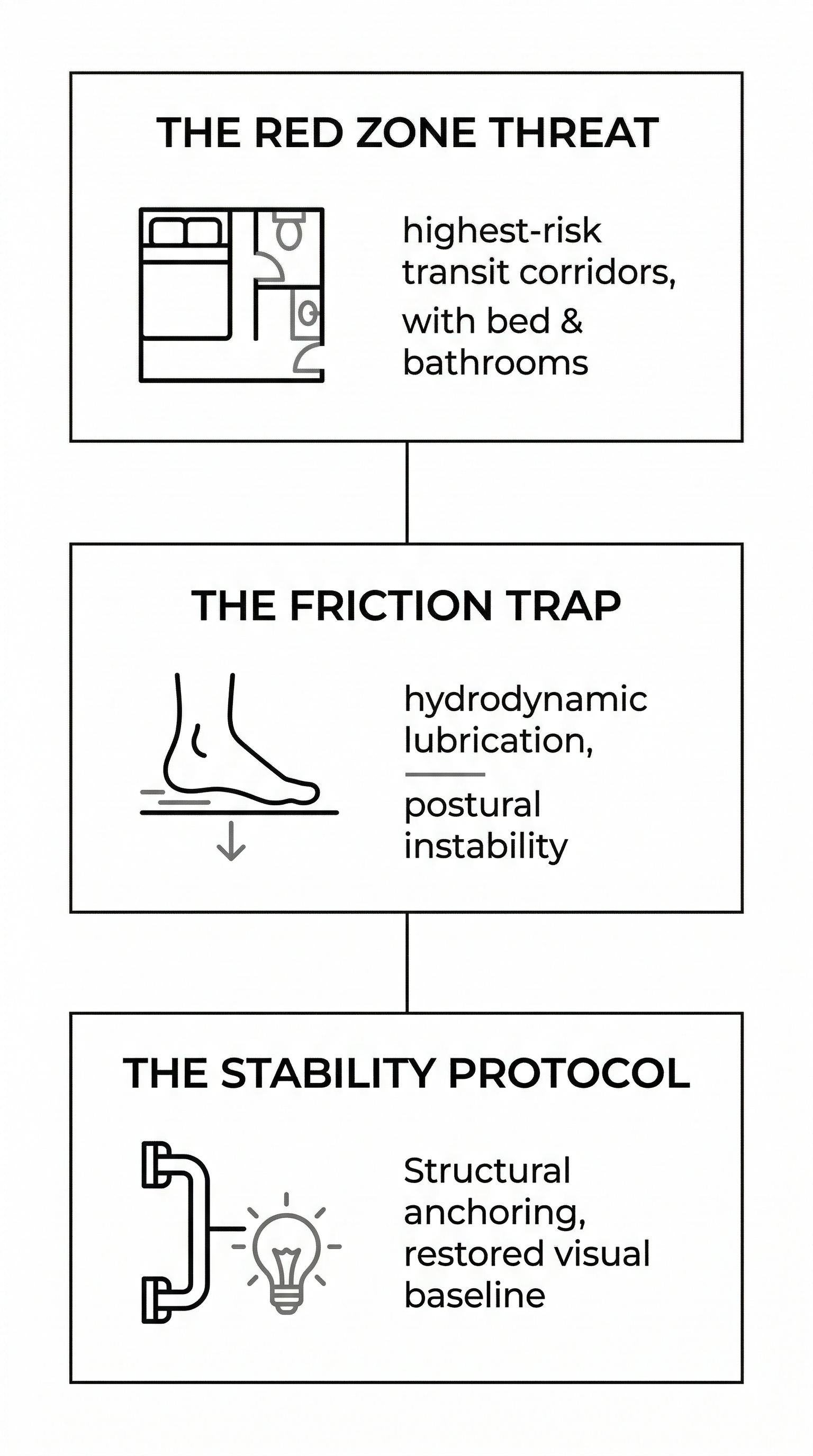
Structural failures occur in the bathroom due to a deterministic breakdown in physics where the required coefficient of friction exceeds the available friction, compounded by compromised sensory data.
A slip in the bathroom is never a random accident; it is an unavoidable physical trap. Navigating a wet floor introduces hydrodynamic lubrication between your foot and the surface.
When soapy water is present, the available friction drops to near zero. If your forward momentum (the required friction) outpaces what the floor can provide, a mechanical failure is mathematically guaranteed. To mitigate this, we must objectively engineer the surface environment to change the physics of the space.
A slip in the bathroom is never a random accident; it is an unavoidable physical trap. Navigating a wet floor introduces hydrodynamic lubrication between your foot and the surface.
When soapy water is present, the available friction drops to near zero. If your forward momentum (the required friction) outpaces what the floor can provide, a mechanical failure is mathematically guaranteed. To mitigate this, we must objectively engineer the surface environment to change the physics of the space.
How does waking up suddenly compromise postural stability?
Rapid postural transitions from lying to standing cause a sudden drop in systemic pressure, temporarily starving the brain of oxygen and compromising the mechanical sequencing required for upright stability.
This phenomenon is known as postural hypotension.
When you lie flat, your cardiovascular system operates at a specific pressure baseline. When you rapidly transition to a standing position, gravity pulls blood downward. If the system does not adapt fast enough to equalize the pressure, the brain experiences a momentary oxygen deficit. This manifests as dizziness or wobbliness exactly at the moment when your base of support needs absolute stability. It is a hardware limitation of the pressure system, not a personal failing.
This phenomenon is known as postural hypotension.
When you lie flat, your cardiovascular system operates at a specific pressure baseline. When you rapidly transition to a standing position, gravity pulls blood downward. If the system does not adapt fast enough to equalize the pressure, the brain experiences a momentary oxygen deficit. This manifests as dizziness or wobbliness exactly at the moment when your base of support needs absolute stability. It is a hardware limitation of the pressure system, not a personal failing.
What role does darkness play in environmental navigation?
Navigating in the dark eliminates visual input, forcing the brain to rely solely on vestibular and somatosensory data, which instantly overloads cognitive bandwidth and compromises postural control.
Human balance is an integrated system relying on visual data, vestibular (inner ear) tracking, and proprioception (your body’s GPS).
Waking up in a dark bedroom eliminates the primary visual data feed. The brain is forced to process complex navigation using limited inputs. Searching for light switches while managing the urge to move quickly overloads your cognitive bandwidth, significantly increasing the probability of a systemic error.
Human balance is an integrated system relying on visual data, vestibular (inner ear) tracking, and proprioception (your body’s GPS).
Waking up in a dark bedroom eliminates the primary visual data feed. The brain is forced to process complex navigation using limited inputs. Searching for light switches while managing the urge to move quickly overloads your cognitive bandwidth, significantly increasing the probability of a systemic error.
The Triage Protocol: Securing Your Baseline
Most falls occur at home during routine activities. By deploying a triage strategy, securing the highest-risk Red Zones first, you can dramatically reduce your statistical likelihood of a structural failure in a single afternoon. Execute the following protocols to neutralize these threats:
Step 1: Restore the Sensory Baseline (Lighting)
Step 2: Execute Friction Engineering
Step 3: Deploy Structural Anchoring
Step 4: Implement the "Sit & Pump" Reflex Sequence
Step 1: Restore the Sensory Baseline (Lighting)
- Deploy motion-sensor lighting along the primary transit corridor from the bed to the bathroom.
- This instantly restores the visual data feed your brain requires to identify spatial obstacles and maintain upright balance, completely eliminating the need to search for switches in the dark.
Step 2: Execute Friction Engineering
- Mechanically alter the physics of your shower and tub surfaces by installing high-grade non-skid decals or engineered rubber suction mats.
- This specific intervention forcefully increases the Available Coefficient of Friction, neutralizing the hydrodynamic lubrication of wet surfaces.
Step 3: Deploy Structural Anchoring
- Install dedicated, properly anchored grab bars inside the tub, outside the tub, and adjacent to the toilet. Towel racks are decorative; they are not rated to support dynamic human body weight and will fail under load.
- Ensure the bed and toilet are calibrated to the correct height (seated knees level with or slightly below the hips). This optimizes leverage and reduces the immense mechanical power required to initiate a standing transition.
Step 4: Implement the "Sit & Pump" Reflex Sequence
- Defeat postural pressure drops by establishing a new operational habit. When waking, sit on the edge of the bed for 60 to 120 seconds.
- Perform sequential ankle pumps before standing. This mechanical sequencing allows the cardiovascular system to equalize pressure, pushing blood back to the brain and neutralizing dizziness before your feet ever commit to the floor.
Operational Baseline Comparison
Establish Your Operational Continuity
Data dictates that falls drive 81% of bathroom injuries and result in over 3 million emergency department visits annually. Do not wait for a structural failure to dictate your lifestyle constraints. Intelligence is the first step. Execution is the second. Stop guessing and establish your operational baseline today.
Take command of your environment.
Download the free 24-Hour Safety Audit or register for a live Thursday Briefing at ISBlueprint.com/audit.
Take command of your environment.
Download the free 24-Hour Safety Audit or register for a live Thursday Briefing at ISBlueprint.com/audit.
Created with