The subtle reality of aging is that the greatest threats to independence do not always announce themselves with a sudden loss of strength. Often, the breakdown happens quietly, in the invisible processing centers of the nervous system. For the adult child attempting to manage a parent’s safety, the focus is typically on physical obstacles: removing throw rugs, installing grab bars, or monitoring medications.
However, one of the most statistically dangerous environments is entirely situational. It happens when an older adult is walking while trying to answer a question, carry a tray of coffee, or process the noise of a crowded room. The individual feels they are simply multitasking, but beneath the surface, their neurological system is quietly failing. We call this the Cognitive Overload Trap.
The Integrated Stability Blueprint™ is a comprehensive risk management framework designed to mitigate biomechanical and environmental variables, equipping aging adults with the systemic protocols necessary to maintain high-agency independence.
Understanding how the brain processes movement is the key to neutralizing the anxiety of unpredictability and establishing a confident, operational baseline for daily living.
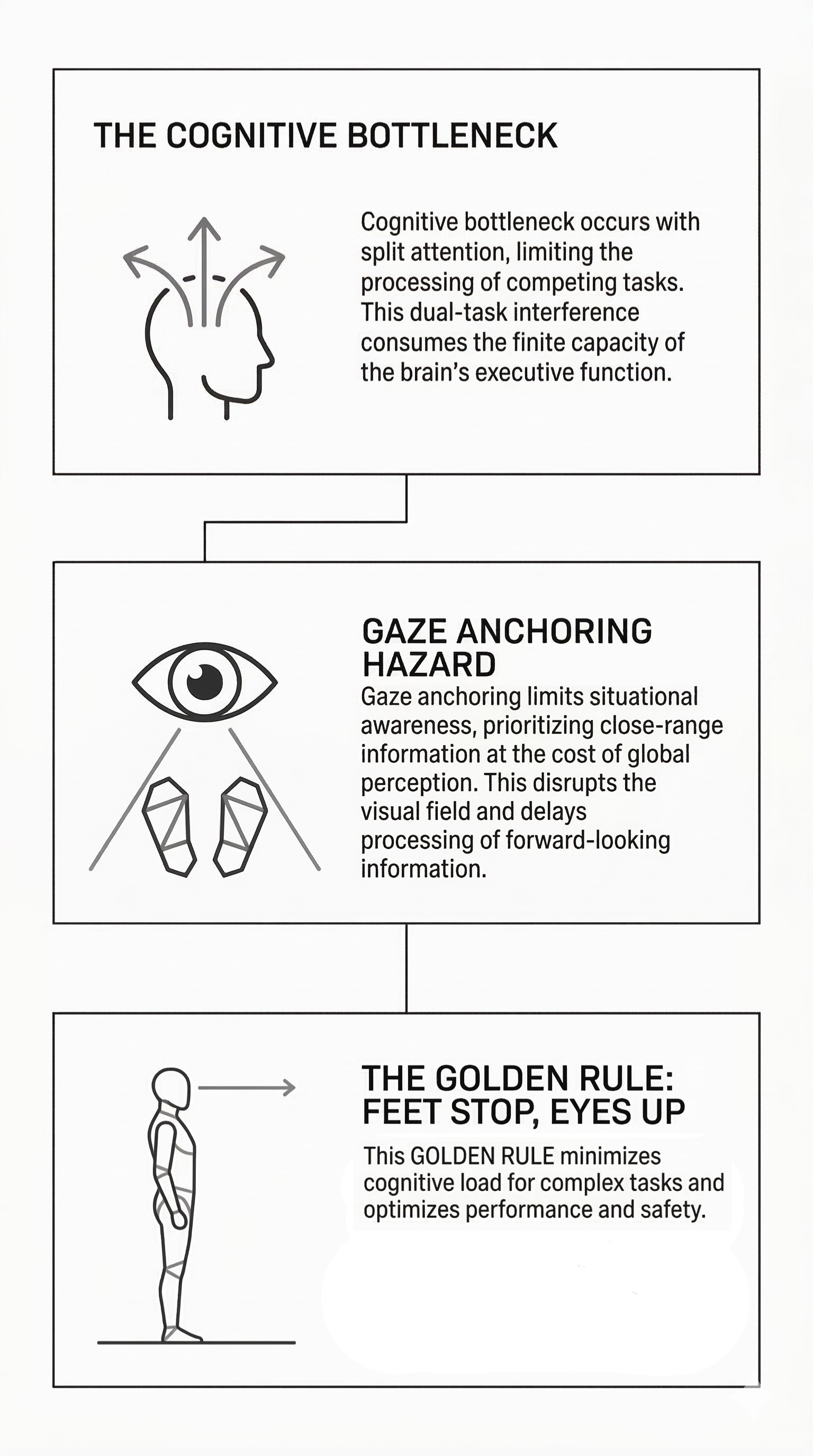
Walking transforms from an automatic, subconscious reflex into a conscious cognitive process managed by the brain's executive center, creating a dangerous processing bottleneck.
In our youth, gait and physical balance are managed by subcortical automaticity—a background system that runs effortlessly while we focus on other things. As the nervous system ages, this automaticity degrades. The responsibility for walking is pushed upward into the prefrontal cortex, the brain's executive processing center. This biological shift is known as the "Corticalization" of gait.
Walking literally requires active thinking. Because the brain is now using its executive center to walk, it processes motor tasks (staying upright) and cognitive tasks (talking, scanning an environment) in a single, finite queue.
Cognitive overload falls occur when a sudden mental demand forces the brain to process simultaneous physical and cognitive tasks, causing the internal stability system to lag or fail.
When an individual with corticalized gait attempts to walk and talk concurrently, they experience "dual-task interference." Biomechanical research measures this through the Dual-Task Cost (DTC)—the quantifiable drop in physical performance when a secondary mental task is added. If gait speed drops by more than 20% during cognitive engagement, it is a robust, clinical predictor of future falls.
A healthy nervous system operates under a "Posture First" mandate; it will instinctively pause a conversation to navigate a trip hazard. A fall occurs when this hierarchy collapses. The brain attempts to maintain the cognitive output (finishing a sentence, reading a sign) at the expense of gait monitoring. Clinical assessments, such as the Walking While Talking (WWT) test, prove that this inability to divide attention effectively is a critical vulnerability. In healthy adults, every 10 cm/sec decrease in WWT speed correlates to a 12% greater risk of developing frailty.
Looking down at the feet cuts off vital peripheral optical flow data, starving the brain of the spatial orientation necessary to remain upright.
When an aging adult feels unsteady, the emotional response is a loss of confidence. This persistent fear triggers a protective, anxiety-induced habit: they look straight down at their feet to ensure safe placement. We identify this as "gaze anchoring."
While this creates a false sense of security, it is highly destructive to physical mechanics. Postural stability relies heavily on peripheral vision and "optical flow"—the pattern of motion across the visual field that detects bodily sway. By anchoring their gaze to the floor, the individual restricts this critical sensory data stream. They become vastly more visually dependent and inherently unstable, leading to a stiff, cautious, and shuffling gait that paradoxically guarantees a higher risk of future falls.
The Operational Solution: Breaking the Processing Bottleneck
To mitigate this complex threat, we cannot simply tell an older adult to "be careful." We must implement a tactical behavioral intervention that addresses the neurological bottleneck and the sensory deficit simultaneously.
Subcortical Automaticity (Youth)
Corticalized Gait (Aging)
Parallel Processing (Walking + Talking easily)
Single-Queue Processing (Bottlenecked)
High Optical Flow (Eyes scanning horizons)
Restricted Data (Gaze anchored to feet)
This simple, highly effective two-step protocol immediately neutralizes the threat of cognitive overload falls. It is designed to respect the user's agency while protecting their physical system.
- Step 1: Feet Stop (Breaking the Bottleneck). When a cognitive demand spikes—such as being asked a question, transitioning across a busy room, or needing to read a label—the individual must deliberately stop their physical forward momentum. By halting foot movement, the dual-task interference is eliminated. The brain is no longer forced to choose between thinking and balancing. Notably, clinical evidence shows that if an older adult naturally stops walking to talk, it is a biomarker indicating depleted cognitive reserve. We turn this deficit into a deliberate, protective strategy.
- Step 2: Eyes Up (Restoring Spatial Orientation). Once stopped, the individual must train their gaze on a stable, vertical target at eye level. This breaks the dangerous "gaze anchoring" habit. Looking out across a room immediately re-engages the peripheral vision, floods the brain with necessary optical flow data, and alters the center of gravity to an upright, commanding posture.
By utilizing "Feet Stop, Eyes Up," older adults regain control over their environment. It translates the anxiety of unpredictability into a measurable, repeatable system of confident mobility.
Establish Your Baseline Today
Intelligence is the first step. Execution is the second. Stop guessing and establish your operational baseline today.
Download the Free 24-Hour Safety Audit or
Register for the live Thursday Briefing at
ISBlueprint.com/audit to secure your tactical risk management plan.