The Floor Recovery Protocol: Neutralizing the Threat of the "Long Lie"
What makes a fall a catastrophic systemic risk?
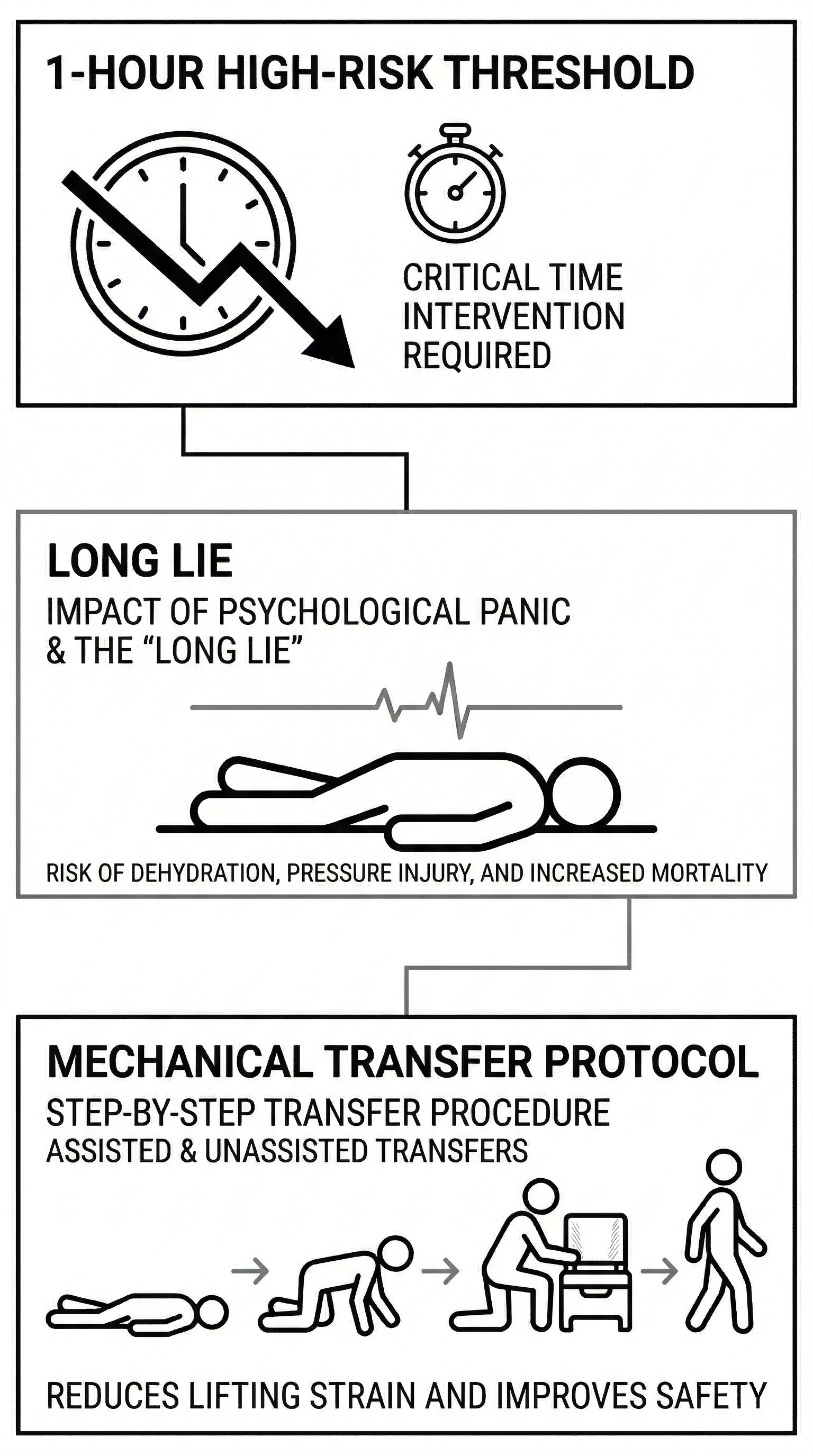
Remaining on the floor for more than one hour triggers a systemic crisis, exponentially increasing the risk of secondary injuries, severe complications, and a permanent loss of independence.
Clinical guidelines universally dictate a strict metric: the 1-Hour High-Risk Threshold. If an individual remains stranded on the ground for 60 minutes or more, the localized event of a fall expands into a systemic threat. It is a well-documented fact that morbidity and mortality rates spike significantly as a direct result of prolonged time spent on the floor.
Clinical guidelines universally dictate a strict metric: the 1-Hour High-Risk Threshold. If an individual remains stranded on the ground for 60 minutes or more, the localized event of a fall expands into a systemic threat. It is a well-documented fact that morbidity and mortality rates spike significantly as a direct result of prolonged time spent on the floor.
The pressure on the body’s internal systems compounds by the minute. To mitigate this, we must deploy a predefined system that guarantees a rapid, safe return to a stabilized position.
The Floor Recovery Protocol is a step-by-step mechanical sequence designed to maximize physical leverage and minimize the need for brute strength, allowing an individual to safely transition from the floor to a standing position.
Why does panic cause secondary injuries after a fall?
Panic triggers a rushed, frantic attempt to jump up, which overwhelms the body's cardiovascular baseline and drastically exacerbates existing physical trauma.
A sudden fall is inherently startling. It invokes a deep sense of vulnerability and shock. Driven by embarrassment or a desperate desire to regain control, the immediate instinct is to rush the recovery. This is a critical error. Abruptly forcing the body upright can cause sudden drops in blood pressure, leading to fainting or secondary falls that are often worse than the initial impact.
The central psychological insight for effective recovery is prioritizing pacing over panic. Taking several deep breaths and resting on the ground allows the nervous system to stabilize. This shifts the brain from a state of emotional overload into a state of deliberate, mechanical problem-solving.
To neutralize the psychological paralysis of the floor, top-tier fall prevention initiatives (including the CDC’s STEADI program) rely on desensitization and muscle memory. By intentionally practicing recovery in a safe environment, we remove the phobia. When the physical response becomes an automated reflex, panic is neutralized.
How does backward chaining mitigate fall trauma?
Backward chaining reverse-engineers the recovery process by breaking the complex mechanism of getting up into isolated, achievable physical links.
Instead of viewing the recovery as one massive hurdle, backward chaining teaches the movements in reverse (e.g., from a chair, down to a kneel, and safely to the floor). This allows individuals to safely master the transitions, proving to themselves that they possess the functional mechanics to control their own bodies. Studies have shown that seniors report falling half as often after just two hours of simulated recovery practice, with the preventative results lasting up to a year.
Instead of viewing the recovery as one massive hurdle, backward chaining teaches the movements in reverse (e.g., from a chair, down to a kneel, and safely to the floor). This allows individuals to safely master the transitions, proving to themselves that they possess the functional mechanics to control their own bodies. Studies have shown that seniors report falling half as often after just two hours of simulated recovery practice, with the preventative results lasting up to a year.
What are the mechanical steps of the Floor Recovery Protocol?
The mechanical transfer relies on a four-step sequence: Roll, Crawl, Kneel, and Pivot. It utilizes environmental support to bypass the need for sheer physical strength.
When a fall occurs, execute the following systematic procedure to ensure a safe transfer from the floor:
When a fall occurs, execute the following systematic procedure to ensure a safe transfer from the floor:
- Step 1: The Assessment and Roll: Do not attempt to sit straight up. Remain completely still to assess for injuries and allow the initial shock to dissipate. Once stabilized, roll onto your side in a fluid sequence: turn the head first, followed by the shoulder, arm, hip, and leg.
- Step 2: The Quadruped Crawl: From the side-lying position, push the upper body off the floor to transition onto your hands and knees. Once a stable, four-point baseline is established, crawl toward a sturdy, immobile object, such as a heavy chair or the edge of a bed.
- Step 3: The Half-Kneel Leverage: Place both hands firmly on the sturdy piece of furniture for support. Slide your strongest foot forward so it is flat on the floor, keeping the opposite knee securely planted on the ground. This establishes maximum mechanical leverage.
- Step 4: The Push and Pivot: Using the combined downward force of your arms pressing into the furniture and the upward drive of the planted front leg, push yourself upward. Slowly turn your body to sit safely in the chair and allow your cardiovascular system to fully recover.
Intelligence is the first step. Execution is the second.
Created with