The most dangerous moment of your parent’s day often happens in silence. It is the morning "Cortical Gray-Out." That terrifying split second after standing up when vision tunnels, the room spins, and consciousness fades.
You might call it "a dizzy spell." They might dismiss it as "just getting old."
Both of you are wrong. This isn't a vague symptom of aging; it is a specific, mechanical failure of the body’s internal pressure systems. It is a hydraulic issue, not a destiny. And because it is mechanical, it can be mitigated.
Here is the operational breakdown of Orthostatic Hypotension, why the pressure drops, why the fall happens, and the "Primer Pump" protocol to neutralize the risk.
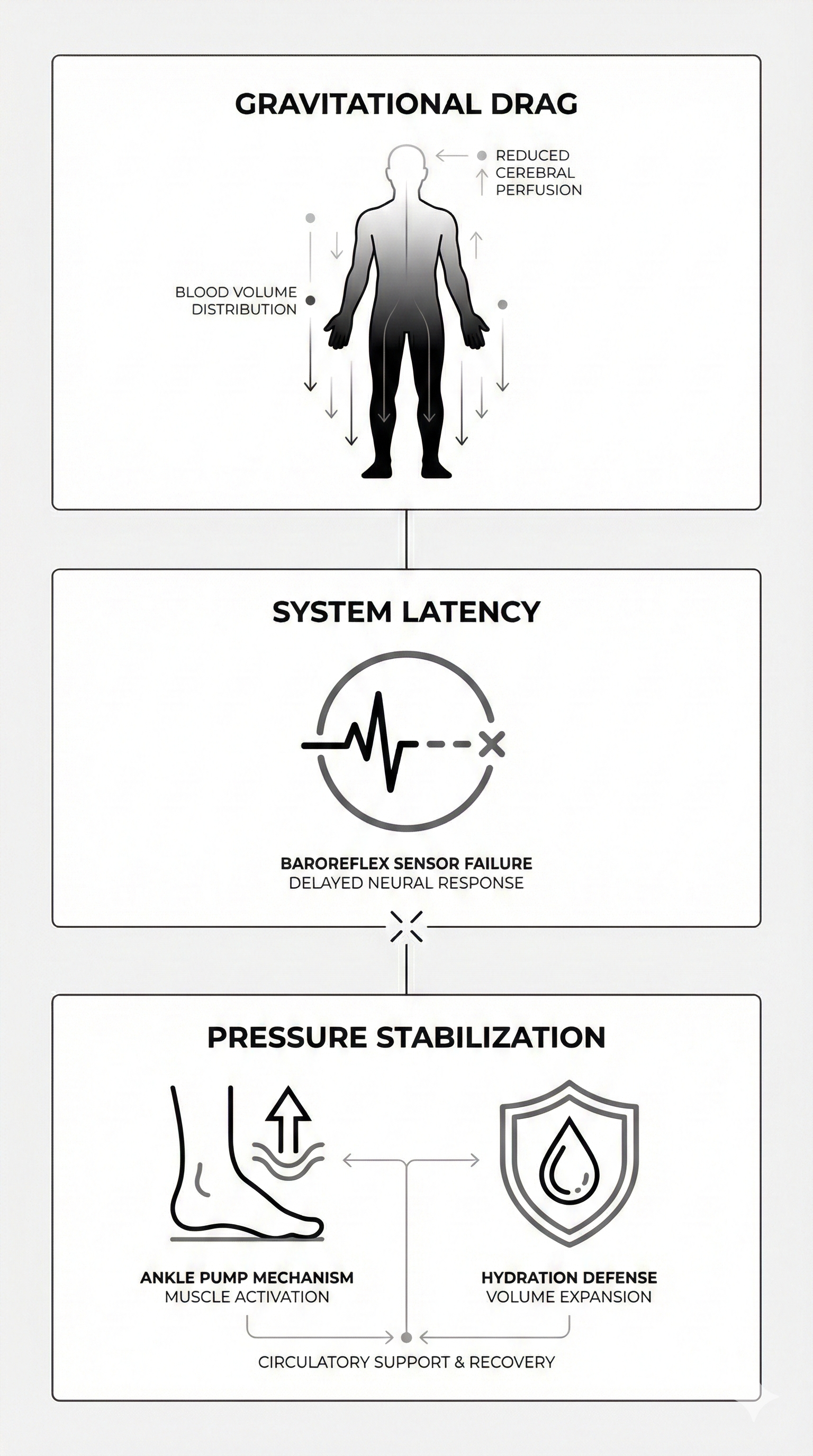
The dizziness is caused by Orthostatic Hypotension (OH), a mechanical failure where the cardiovascular system fails to fight gravity, causing blood to pool in the lower extremities and temporarily starving the brain of oxygen.
When a person stands, gravity immediately pulls blood downward into the legs and the abdominal bed. In a young, healthy body, an internal pressure sensor called the baroreflex detects this drop instantly. It triggers the blood vessels to constrict and the heart rate to increase, forcing blood back up to the brain against gravity.
In many older adults, this sensor is blunted or delayed. The vessels fail to constrict, the system pressure drops, and the brain experiences a temporary blackout.
Orthostatic Hypotension (OH) is defined medically as a sustained reduction of systolic blood pressure of 20 mm Hg or more, or diastolic blood pressure of 10 mm Hg or more, within 3 minutes of standing
This dizziness is a critical red flag that increases the risk of falling by 40% to 60% and is a leading cause of hospitalization in older adults.
The danger is not just the sensation; it is the timing. There is a phenomenon known as "Initial Orthostatic Hypotension" (iOH), which causes a massive pressure drop (greater than 40 mm Hg) within just 15 to 30 seconds of standing.
This is the 15-Second Danger Zone. It occurs exactly when the motor demand for walking is highest for example, transferring from the bed to the bathroom. If the brain "grays out" while the legs are trying to navigate to the toilet, a catastrophic fall is almost inevitable.
Dehydration acts as a "force multiplier" for dizziness by reducing blood plasma volume, leaving the cardiovascular system without enough fluid to maintain upward pressure.
Think of the body as a closed hydraulic loop. If the vessels don't constrict because of nerve damage or medication, you need more fluid in the system to maintain pressure. If the individual is dehydrated, plasma volume drops.
Many aging adults are also on a "System-Depleting" cocktail of medications:
- Diuretics: Actively flush fluid volume out of the system.
- Alpha-blockers: Prevent the blood vessels from constricting to push blood upward.
The Solution: The "Primer Pump" ProtocolWe cannot always fix the broken sensor (the baroreflex), but we can manually override the system. We deploy the Primer Pump Mechanism.
The Primer Pump Mechanism is a set of pre-movement physical actions that utilize the skeletal muscle to mechanically force venous blood from the lower extremities back to the heart before standing.
Step 1: Mechanical Priming (Before Standing)
Do not let them stand cold. Execute these actions while still sitting on the edge of the bed:
- Ankle Pumps: Flex the foot up and down rapidly for 30 seconds.
-
Heel Slides: Slide the heel back toward the chair/bed, engaging the hamstring.
-
The Squeeze: Clench thigh and glute muscles to compress the deep veins.
Step 2: Volume Maintenance (Daily)- Fluid Loading: Aim for 6–8 glasses of water daily to keep system volume optimal.
-
Sodium Management: Consult a doctor about salt intake; sometimes, a slight increase helps retain necessary fluid volume in OH people.
Step 3: External Pressure (The Casing)- Compression Stockings: These act as an external casing for the lower extremities, physically preventing blood from pooling in the calves.
-
Abdominal Binders: Compression around the waist prevents blood from pooling in the gut (splanchnic bed) after meals.
Stands up immediately ("Pop and drop")
Low plasma volume (Dehydrated)
Passive legs (Gravity wins)
Cortical Gray-Out & Falls
Staged Transition: Sit -> Dangle -> Pump -> Stand
High plasma volume (Optimal system volume)
Active Muscle Pump (Muscles push blood up)
Hemodynamic Stability & Confident Living
You now understand the mechanics of why they fall in the morning. It’s not a mystery; it’s a pressure failure. But understanding the dynamics is only one component of a comprehensive risk management strategy.
Stop guessing and establish your operational baseline today.
Option 1: Download our free 24-Hour Safety Audit to execute a Risk Reality Check on their environment.
Option 2: Register for our live Thursday Briefing for a complete operational breakdown of the Integrated Stability Blueprint.